Ballyglass Heart Space
Blessed by the ancient well (now piped)
You enter past the house cum crumbled barn,
Crossing the stream by Peggy’s gable.
Heading straight passed new life left,
On past the avenue to our Lynskey neighbours
Past an exhausted quarry
The path turns right,
Working farmyard to the left
And the latter day homestead right,
Its heart still glowing
Though its yard and barns are stilled.
Enter by the weathered stile,
to lush grass around the fort of ancient times.
A hill excavated and rebuilt by the fearful
A millennium ago,
Hiding themselves, stock and crops,
Within a walled souterrain
Sealing secrets past.
Stop.
Your choice now
To gaze
Houseward to family memories,
The clachan of Kenny homes
Clustered survival through an Gorta mor.
Out into open fields east
Or downward
Into mystery.
Begun Sep 1998
Children of the Photo
“Once upon a time neither in your time nor my time but better times when the streets were paved with penny-cakes and the houses were thatched with pancakes a pig would run out of a lane with a knife and fork in his back crying out ‘Who will eat meat, who will eat meat”. At that time there lived in Ireland a king whose wife was very beautiful…“
This example of the fluid and fantastic story-style of Peter Lynskey of Ballyglass, Kilconnell, County Galway was recorded as part of a national folk survey by the Irish schoolchildren of the 1930s. But, no such fantasy is needed to chronicle the lives of the children of that era, such as we see here.
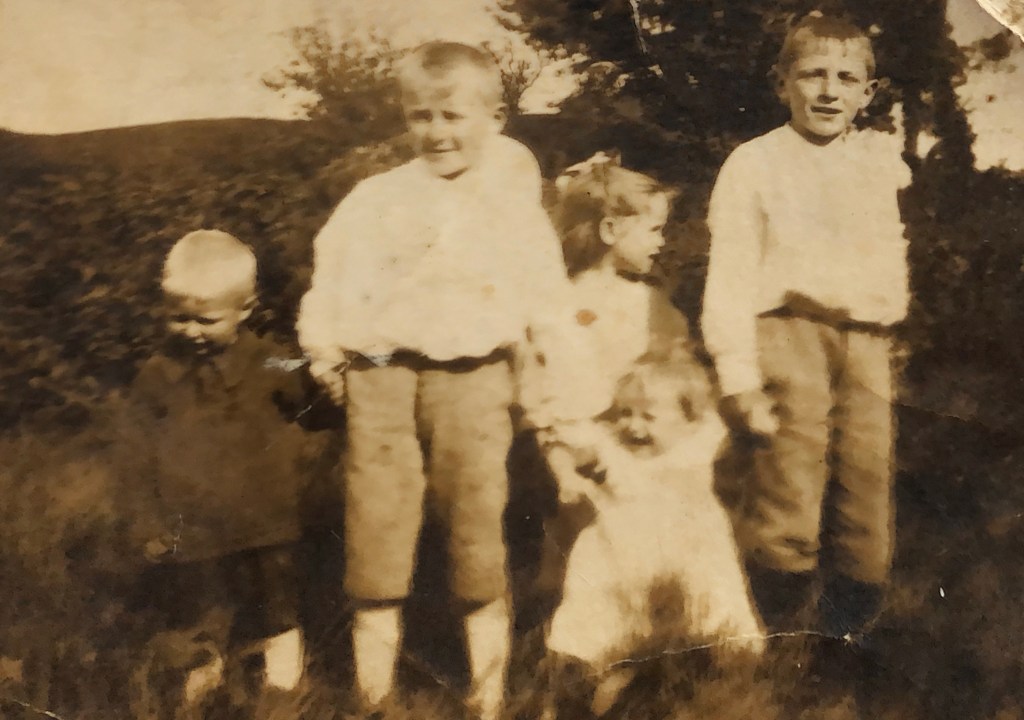
Consider the children of the 1923 photo which I call “The Irish free state” which features my father Sean and his brothers and sisters. The children stand together but look away from the camera in varying directions. A picture perhaps of the spirit of the newly-created semi-independent Irish Free State.
Ballyglass free state
Denis found his match in Craughwell,
Farmed the land, its crop and stock.
Matthew gazed away but stayed close,
Maura, enclosed by others’ needs, kept a free mind,
Sean, every return re-exiled, wiped tears from his eyes,
Whilst wild child Philly was calmed by Ghana.
Friday pm, 1 Nov 1996, soon after dad Sean’s death.
A night at the movies
Chasing that hen for the last of the dozen
Escaping on her brother’s bike
Blumpclunking to the shop with sixpence credit
A penny for jam
A penny for a loaf
And four pence for McFadden’s Magic Lantern!
Kitty and Katty are there,
Local lads too, throwing turf-scraws at the screen
When reels are changed.
An evening long-remembered
(Buster Keaton a bit part in memory’s epic).
Buster played second-string to the loaf
Torn to shreds as they shrieked their way home,
Small-handed Katty in and out the jar
Smearing jam on sawn-off slices,
All hands washed at the bridge
So’s not to be too savage.
Haagen-Daz at the multiplex?
Another
(Not so tasty)
World.
An evening out for the Galway girls of the 1940s.
Absolution
Communal confession
Bright seventies idea, abandoned by the eighties
Disapproved as loosening the bond
Twixt priest and penitent.
Sad news for stadia of shy tongue-tied
Preferring forgiveness in a crowd.
Communal confession nineteen-thirties style:
Fr O’Neill vexed on his horse,
Champing to escape his flock of pious children.
Their keen veniality
Pricking the patience of his mount,
Drawing pardon from exasperation:
‘Ah sure, ye’re fine’
Now mind me way!’
He blessed and the Red Sea parted
To exchange grace in Killagh
For gravy in Loughrea.
My mother often referred to this episode, the prodigal pardon giving her great amusement. The poem contrasts this with the hesitation of the Catholic Church to encourage general (communal) absolution.
Oral Tradition
Poetry?
We were damned learning reams of it,
Famished with the cold
And starving with the hunger!
Our one thought:
Thomas Lally’s field of blood-red turnips,
That was poetry.
Home time from Killagh school
And Lally livid at our early harvest,
That was poetry.
You didn’t write it,
You et it.
Jan 98
My mother’s take on the oral tradition.
From Galway, Abroad
Send no more snaps
‘Send no more snaps of yeerselves,
We know what ye look like.
Send us pictures of Lincoln,
Dollar bills!’
The long- awaited letter from home
Proved justification of the weary choice
To take the boat and leave them
To their grasping.
Snatch away
At our absence.
The quote is a paraphrase of a letter written from Ireland to an emigrant in the USA. For me it expresses something of sadness of the emigrant finding exploitation instead of encouragement, even from those who are his family ‘at home’.
Over there
Missing presumed wastrel.
Absent from the daily inspection.
Overseas with his sister.
Adjudged a loser.
Shocked no-one dying young.
A surprising condemnation
Of an uneventful life
A verdict built
On the sure foundation
Of ignorance.
‘How could he have been happy
So far from home and hearth?
How could he have been any good
And we not know of it?’
Poem inspired by the discovery that a great-uncle, said to have died young as an alcoholic on the streets of New York, in fact lived a sober and uneventful life in New Jersey.
 A Wondering Return